_edited_edited.png)
Structural Readiness Before Capital
Structural Readiness Before Capital
If this raise slows from here, would you know what's breaking underneath it?
If it fails, it won't fail loudly.
It will fail in the room—in ways you can't recover from.
Most founder-led companies approaching a capital raise discover that growth momentum and structural readiness are not the same.
Glenmore assesses institutional readiness for founder-led companies approaching consequential capital events.
We examine decision rights, operating and reporting discipline, and capital sequencing — before institutional investors do.
Capital does not create readiness.
It exposes what already exists.
→Seek A Readiness Determination
Glenmore engages selectively and works with a limited number of companies each year.

I work with founder-led companies approaching structural inflection points — where growth ambitions are increasing, but internal structures must be tested.
In these moments, ambition accelerates — but decision clarity, authority lines, and reporting discipline begin to strain.
Suren Ramlochun, Principal

Capital Tests Structure
Capital does not remove structural weakness. It institutionalizes it.
Most companies do not fail because their product was wrong.
They fail because:
• capital arrived before structure
• growth arrived before governance
• momentum arrived before judgement
Institutional capital amplifies what already exists.
We challenge timing, not ambition.
When capital becomes available, we test whether decision architecture and operating systems can sustain institutional scale. Where misalignment exists, we harden structure before crystallization.
If structure is weak, fragility scales.
If structure is sound, strength compounds.
Glenmore operates at the transition between
“this might work” and “this is ready to scale.”
What Glenmore Does
Most companies don't lose momentum because the business isn't working. They lose it because something underneath it doesn't hold when examined properly.
Glenmore works with founder-led companies at consequential capital inflection points — assessing governance architecture, operating discipline, capital sequencing, and execution control before institutional investors do.
A determination is conducted prior to institutional diligence — when structural issues can still be addressed, not negotiated around.
We clarify who truly holds decision authority, how governance functions under pressure, and whether operating systems can withstand investor scrutiny.
When authority is implied rather than defined, capital formalises ambiguity instead of eliminating it.
Glenmore ensures internal architecture withstands the scrutiny of serious institutional capital.
When Founders Call
Founders don't usually reach out when things are broken. They reach out when something no longer feels clean — but can't yet be explained.
-
Investor conversations are tightening — but the structure hasn’t been tested
-
Board pressure is building — but governance isn’t formalized
-
Growth is exposing operational strain — but systems haven’t caught up
-
Financial complexity is outpacing internal controls
What This Looks Like in Practice
A company entered diligence with strong revenue and clear demand.
During review, financial reporting could not reconcile consistently across periods.
The numbers were not incorrect.
They were not structurally reliable.
Diligence slowed.
Terms shifted.
Confidence eroded.
Nothing about the market changed.
Only what could be proven did.
The business didn't fail.
The moment did.
If this were your company, would your numbers reconcile cleanly under scrutiny — or only until they are tested?
These signals don't appear all at once. They accumulate quietly — until capital forces clarity.
The founder who acts before that moment keeps the decision in their hands. The founder who waits discovers what institutional capital exposes — after it’s already entered the system.
When Capital Allocators Call
Most diligence processes assess the opportunity. Few assess whether the organization can actually carry it.
Allocators engage Glenmore because they’ve seen what happens when structural readiness is assumed rather than verified.
-
A company looked strong from the outside. Governance was founder-dependent.
-
Capital was deployed. Operating discipline hadn’t been built for that scale.
-
The raise closed. Then the real structural work began — at the allocator’s cost.
What This Looks Like in Practice
A company presented well at the surface.
Governance was founder-dependent.
Financial controls had not scaled with growth.
Capital was deployed.
The operating strain surfaced after the investment — not before.
The structure didn’t fail immediately.
It failed under load.
Nothing failed during the raise.
It failed after the capital arrived.
The loss wasn't immediate.
It was structural — and already embedded.
Glenmore exists at the point before these problems are created.
We provide allocators with an independent structural determination on companies approaching their pipeline — before term sheets are signed, before capital is committed, before the structure is locked in.
Most diligence processes assess the opportunity. Glenmore assesses whether the organisation can carry it.
That is a different question. And it has to be answered by a firm with no stake in whether the deal closes.
How This Begins
Every engagement begins with a confidential initial submission. The objective is not evaluation for its own sake — but to determine whether structural clarity will materially change the outcome of a capital event.
Glenmore determines whether the conditions for a formal readiness determination are present.
Where both parties find grounds to proceed, a full determination is conducted as a defined, fixed-scope project.
The output is not a growth plan. It is structural clarity.
Structural readiness determines the path forward. Not ambition.
Founders often have the ambition. The question is whether internal architecture can sustain institutional scale.
The Strategic Readiness Gap
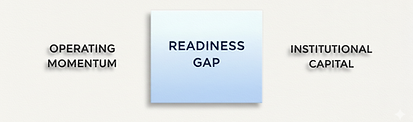
The Strategic Readiness Gap There is a critical transition point in every growth journey — the moment when what got you here is no longer enough to satisfy the requirements of institutional-grade capital. This is the Readiness Gap: where a company’s position is either solidified through structure or quietly eroded by perceived risk. Glenmore operates within this gap — before capital decisions harden outcomes. Capital can reduce pressure. It cannot substitute for structural completion.
The instinct to raise is often driven by urgency.
The discipline to prepare is what compounds.
Capital can reduce pressure. It cannot substitute for structural completion.
Relief and culmination are not the same.